 By
By 
Anyma’s ÆDEN was never just a visual show.
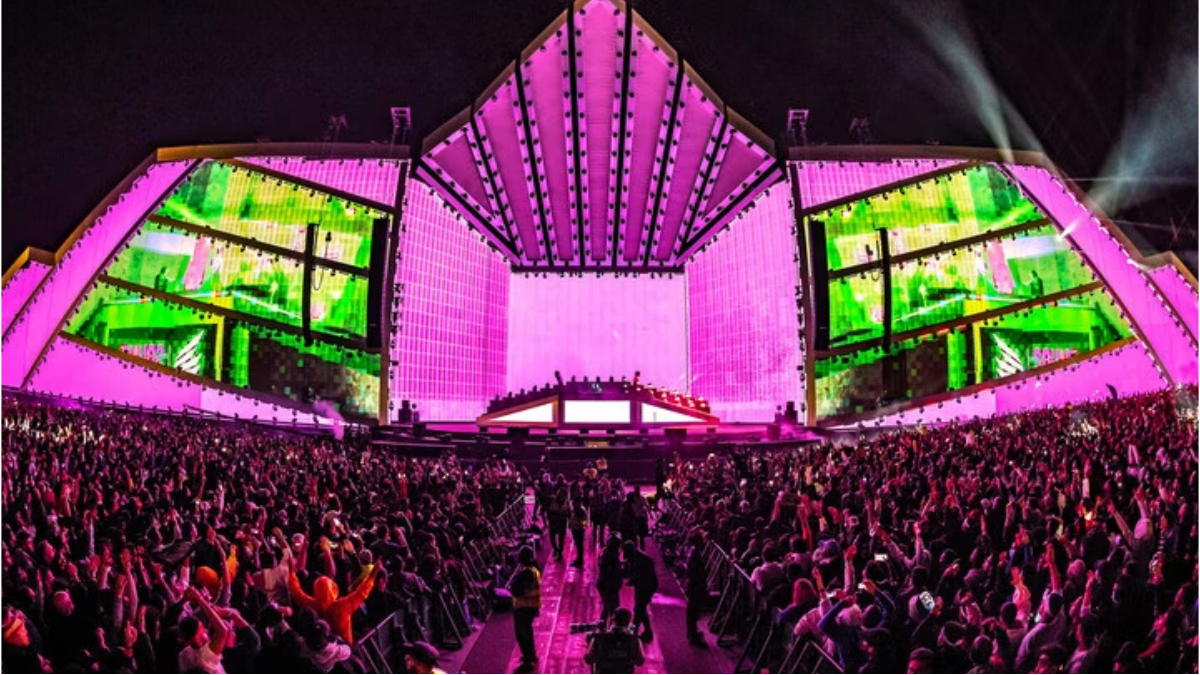
Behind the world he brought to Coachella 2026 lies a deeper creative philosophy: the idea that mythology, technology, digital systems, and human emotion can exist together inside one live performance universe.
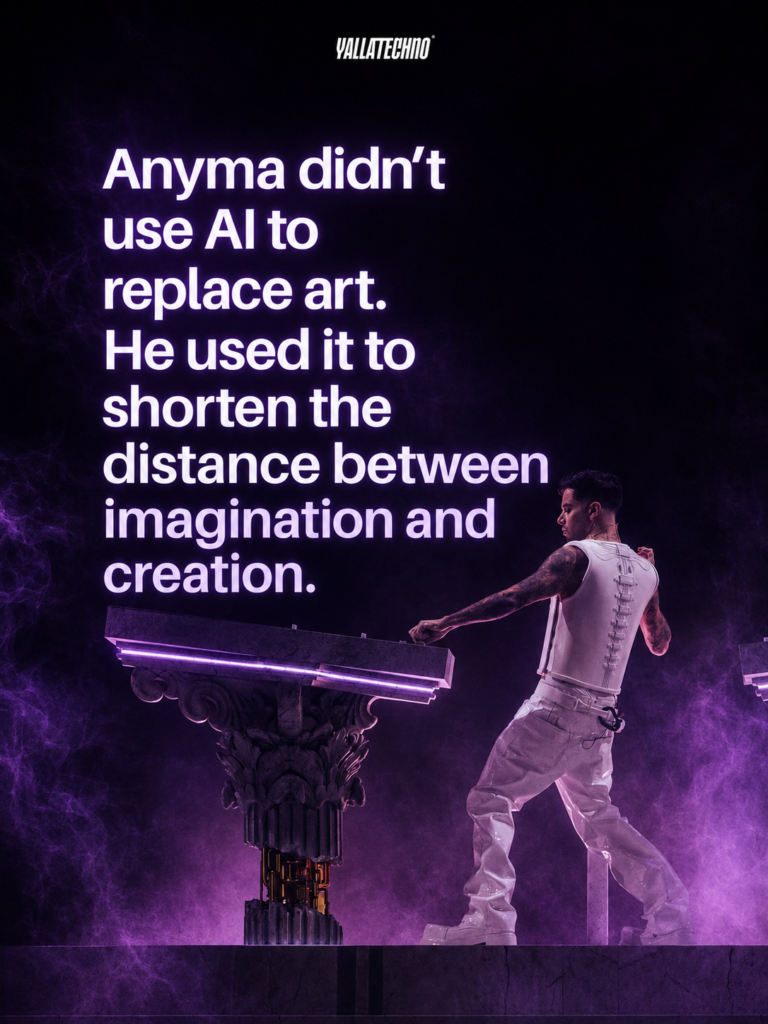
In the official behind-the-scenes video, Anyma explains that ÆDEN began as a world he had been building in his head for a long time — shaped by ancient myths, philosophical notes, classical art, sci-fi ideas, and a desire to create something that had no clear reference point before.
This was not simply about using technology to make bigger visuals.
It was about building a new language for electronic music performance.
A World Where Mythology Meets Digital Systems
One of the most important ideas behind ÆDEN is the coexistence of the ancient and the futuristic.
Anyma describes the project as a world where mythology and digital systems could live together in harmony. That tension is what makes ÆDEN feel different: it does not look purely futuristic, and it does not feel purely ancient. It exists somewhere between both.
The visual identity of the project appears to borrow from classical art, ancient symbolism, digital architecture, and emotional human movement — creating a universe that feels timeless rather than trend-based.
For Anyma, timelessness seems to be the deeper goal. Not a viral moment. Not just a stage design. But a world that can stand on its own.
Technology Did Not Replace the Art
The biggest misunderstanding around ÆDEN would be to reduce it to an AI project.
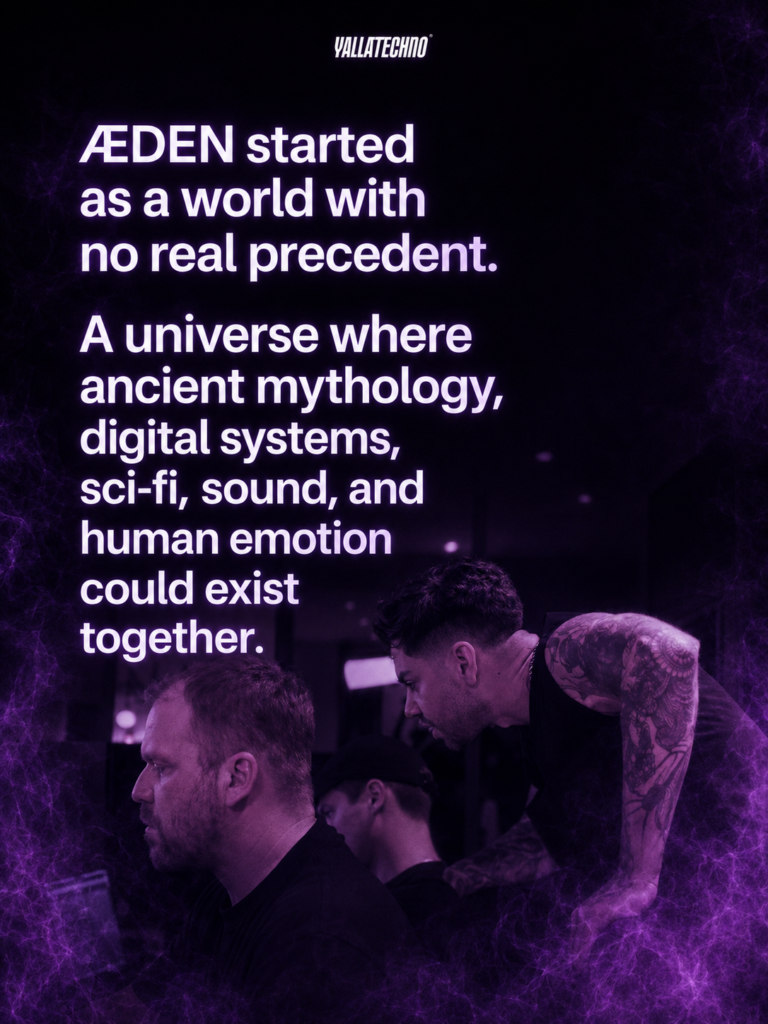
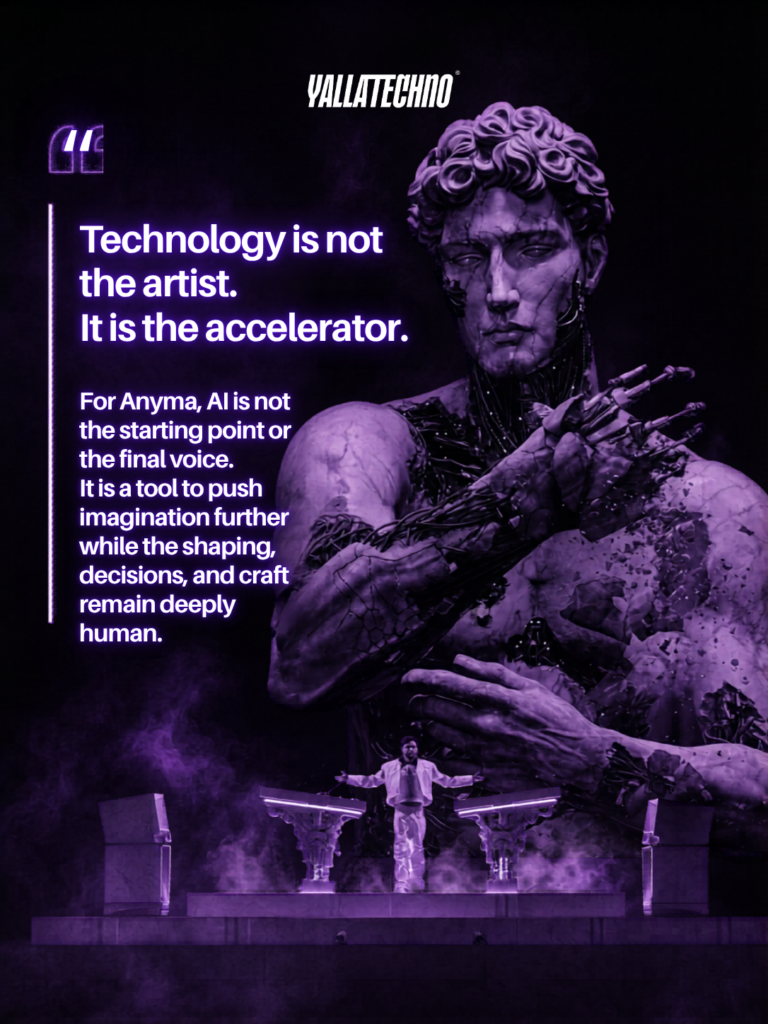
In the video, the message is clear: technology was not the artist. It was the accelerator.
Tools from Google Gemini and DeepMind helped Anyma and his team explore early ideas, generate visual directions, and move through thousands of iterations across form, angle, movement, and perspective.
But the final creative work was not left to the machine.
The vision, taste, decisions, refinement, animation, sound, choreography, and final execution remained deeply human.
That is the real point of ÆDEN: AI did not replace the artistic process. It shortened the distance between imagination and creation.

Human Craft Was the Final Voice
After the early visual exploration, the project returned to human hands.
What audiences experienced at Coachella was the result of months of work across image research, composition, sound, modeling, animation, movement, and collaboration. Anyma also highlights that the team behind the project was not a huge studio, but a small handpicked group of people with precise skills and deep trust in each other’s process.
That detail matters.
ÆDEN was not built by technology alone. It was shaped by human taste, human discipline, and human collaboration.
The AI tools helped open possibilities, but the world only became meaningful when artists, designers, animators, choreographers, dancers, and musicians gave it form.
Why Human Movement Matters in a Digital World
One of the most interesting parts of the ÆDEN process was the use of choreographers and dancers to shape the movement of digital characters.
This is where the project becomes more than visuals.
Digital characters can look impressive, but without human movement, they risk feeling empty. By grounding those characters in real choreography and physical emotion, Anyma gave them weight, intention, and emotional presence.
That is why ÆDEN feels connected to performance rather than only screen design.
The body is still central.
The emotion is still human.
The technology simply becomes another layer of expression.
ÆDEN and the Future of Live Electronic Music
ÆDEN points toward a new direction for electronic music shows.
The future may not be only about bigger LED screens, more lasers, or more expensive production. It may be about building complete worlds — with their own mythology, visual language, emotional logic, and performance identity.
Anyma’s project suggests that the next generation of live performance will not be defined by AI alone. It will be defined by how artists use technology to expand their imagination without losing the human soul behind the work.
That is why ÆDEN feels important.
It is not just a show made with new tools.
It is a statement about what happens when ancient mythology, futuristic systems, and human creativity collide.
Final Thought
Anyma’s ÆDEN asks a bigger question than whether AI belongs in art.
It asks what artists can build when technology becomes a collaborator rather than a replacement.
The answer, at least in this case, is a world where imagination moves faster — but the final vision still belongs to human hands.
Related reading: Why Anyma’s ÆDEN Records Could Matter for the Future of Melodic Techno.