 By
By 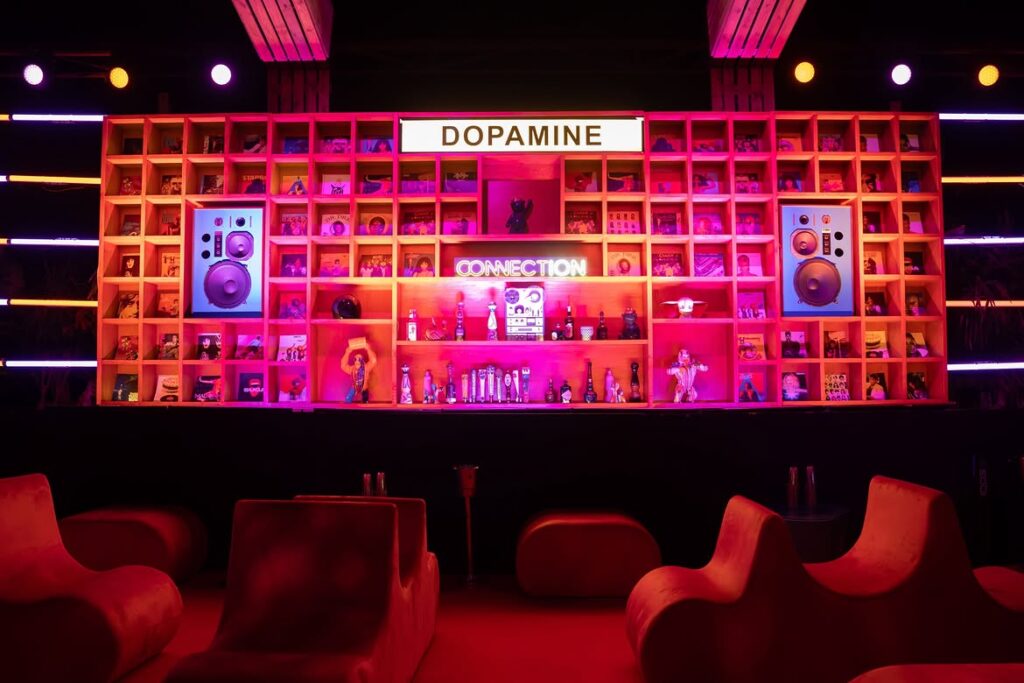
Dopamine Festival returned to Almaza Bay for its second edition on August 20 with a concept designed to challenge the increasingly divided structure of modern festival culture: no VIP area, no traditional backstage separation and no distance between the DJs and the crowd.
Instead, the festival placed both artists and audiences within the same shared environment, keeping the dancefloor at the centre of the experience. This approach was especially visible at Dopamine Festival Almaza Bay, where interaction was key.
Argy Returns to the Pyramids with NEWORLD in November 2026
Returning to the Roots of Club Culture
The idea is simple, but it reflects one of the principles on which club culture was originally built. Moreover, the DJ was part of the room rather than separated from it. This allowed the energy to move continuously between the booth and the dancefloor. The feeling was emphasized at Dopamine Festival Almaza Bay.
With Dopamine, that relationship was brought into a larger festival setting. This was done by removing some of the physical and social hierarchy commonly found at contemporary events.
Eliminating VIP access does not automatically make a festival more authentic. Nor does it solve every issue surrounding modern nightlife culture. However, it does create a different social environment.
At a time when premium areas and exclusive experiences have become standard, Dopamine is building its identity around shared access, participation and proximity to the music.
Spotify Reveals Egypt’s Top 10 Most-Streamed House Tracks in Q2 2026 — Exclusively with Yalla Techno
A Lineup Connecting the Local and International Underground
Musically, the festival assembled a lineup that reflected the same club-focused philosophy. Notably, Dopamine Festival Almaza Bay brought together amazing talents who contributed to the atmosphere.
Leading the international roster was German-Turkish DJ and producer Butch, whose career has moved between house and techno through releases on labels including Innervisions, Diynamic, Rekids and Desolat.
He was joined by Manda Moor, Demi Riquísimo, Julian Anthony and London-based DJ and Beeyou Records co-founder Laidlaw. Together, they brought a broad range of house, techno, acid, Italo, disco and UK-influenced sounds to Almaza Bay.
View this post on Instagram
Egyptian Artists at the Centre of the Festival
The Egyptian lineup was equally important to Dopamine’s identity.
A-Drop B2B Neshow, Aftersunday, Awadly B2B Misty, Beedz B3B Amr B3B Kokey, Delrady, Didier, Ian, Riad B2B Mizo Sultan and Youssef Roshdy extended the programme across the festival’s different rooms. They also covered various musical directions.
Rather than building the entire night around a single headliner, Dopamine offered several entry points into its sound. The international artists provided global weight, while the Egyptian acts reinforced the idea that the local scene was not simply supporting the festival—it was central to its identity.
View this post on Instagram
Can a Festival Still Feel Like a Club?
That remains the most interesting question behind Dopamine. In fact, Dopamine Festival Almaza Bay raises this question through its structural choices.
Festivals and clubs do not naturally operate in the same way. Specifically, festivals bring larger productions, greater capacities and different patterns of crowd movement. On the other hand, clubs are usually more concentrated, physical and responsive to the relationship between the booth and the floor.
Dopamine’s second edition tested whether some of that intimacy could survive as the format expanded.
Removing VIP and backstage divisions was therefore more than a logistical decision. In fact, it was an attempt to move the focus away from status and back towards participation. The DJ remained central to the experience without becoming inaccessible. Meanwhile, the audience became part of the atmosphere rather than simply observing it.
Dopamine’s Place in Egypt’s Festival Landscape
The experiment arrived at an interesting moment for Egypt’s North Coast. Electronic music has become an increasingly important part of the summer calendar.
Ultimately, the strength of the concept depends not only on removing barriers, but on what happens once the music begins. When the crowd responds, the DJ reacts and the room moves together, a festival can begin to recover the intimacy of a club.
At Almaza Bay, Dopamine’s proposition was straightforward: no VIP, no backstage and no separation—just the DJs, the crowd and the dancefloor. To sum up, Dopamine Festival Almaza Bay is redefining the festival experience for Egyptian nightlife.